|
<< Click to Display Table of Contents >> Frequencies - Non-IV |
  
|
|
<< Click to Display Table of Contents >> Frequencies - Non-IV |
|
Frequency tables may be set up for both IV and Non-IV order entry. Each table must be set up separately.
The Frequency Table sets standard administration times for frequency codes entered in Frequency of Non-IV & PRN Order Entry. Standard administration times display on the following:
•Pharmacy Labels
•Cart Fill List
•Catch-Up List
•Active Order List
•EMAR
Cart Fill and Catch-Up Lists use the Frequency Table in conjunction with Cart Exchange Time set up in the Pharmacy Control Information Table to determine the number of doses needed for a specified cart fill.
Select Web Client > Tables > Clinical > Frequencies - Non-IV
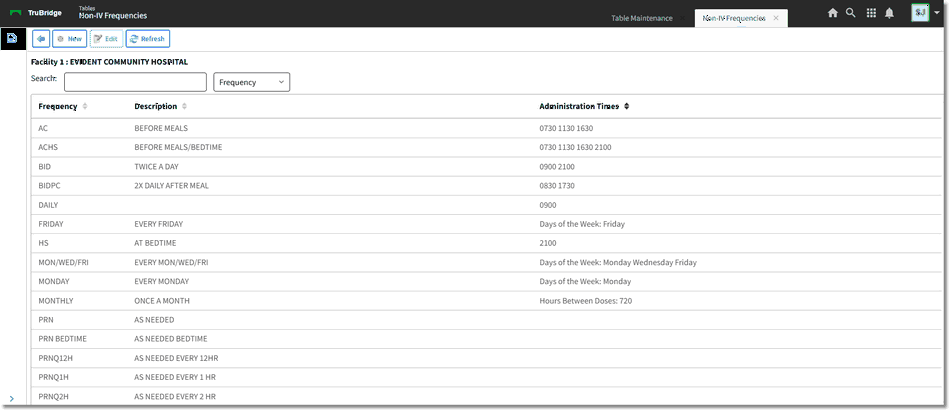
Non-IV Frequency Table
Select New to create a new frequency or select a frequency and Edit to update an existing frequency.
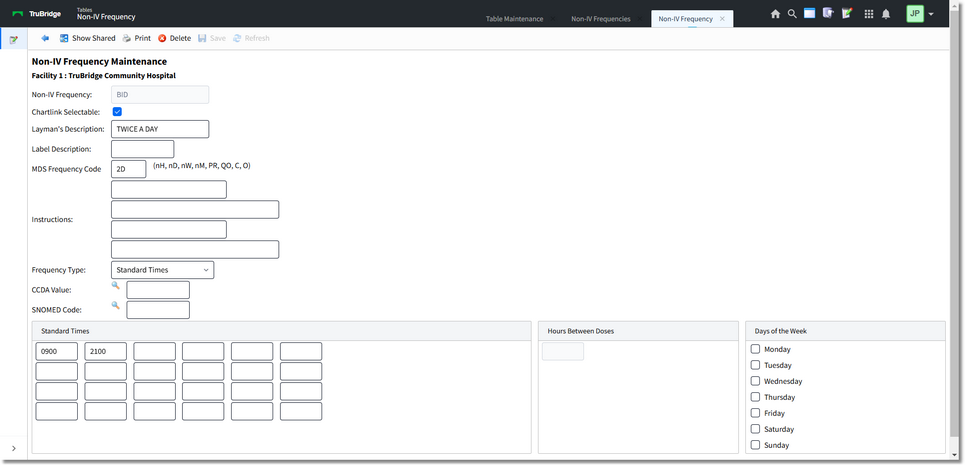
Non-IV Frequency Maintenance
•Action Bar
▪Show Shared: Not functional
▪Print: Print a copy of the selected frequency setup.
▪Delete: Delete the selected frequency.
▪Save: Save updates made to the selected frequency.
▪Refresh: Reset the screen to display any updates made on the selected frequency.
•Non-IV Frequency
▪Default: Blank
▪Options: Up to a 20-character frequency code.
▪Usage: Describes the frequency. The frequency can be selected by description from a lookup display during time of order entry.
•Frequency Types
▪Standard Times
▪Default: Blank
▪Options: Administration times entered in military format.
▪Usage: Up to 24 times can be entered.
▪Hours Between Doses
▪Default: Blank
▪Options: Enter the number of hours between doses.
▪Usage: The system will calculate administration times based on the start time of the order.
▪Days of the Week
▪Default: Blank
▪Options: Choose some or all days of the week.
▪Usage: Administration time for the selected day(s) is based on the start time of the order.
•Chartlink Selectable
▪Default: Blank
▪Options: √ (yes) or Blank (no)
▪Usage: Allows the frequency to be selectable from a drop-down box in the CPOE application.
•Layman's Description
▪Default: Blank
▪Options: Up to a 20-character Layman's term.
▪Usage: Was traditionally used with the Discharge Summary and Instructions application in the Point of Care application. Converted the frequency to Layman's Terms in the medication section of the Discharge Instructions Report. However, now the system uses the Layman term set up in the Prescription Entry Frequency crosswalk table.
•Label Description
▪Default: Blank
▪Options: Up to a 10-character label description.
▪Usage: Allows a frequency description different than the one entered during order entry to print to the label. The description prints to the label ONLY and does not affect printed reports.
•MDS Frequency Code
▪Default: Blank
▪Options: Two character MDS (Minimum Data Set) frequency code.
▪Usage: Used for facilities using the RAI application.
•Instructions
▪Default: Blank
▪Options: Up to four lines of instructions.
▪Usage: Allows up to four lines of instructions pertinent to the frequency to be predefined. Upon entry of a frequency in Employee/LTC order entry, the predefined frequency instructions automatically display.
•Minimum Time Between PRN doses
▪Default: Blank
▪Options: Hours and minutes
▪Usage: Only accessible with PRN frequencies. Works in conjunction with the Medication Verification application. Sets a minimum time range for nursing administration of PRN doses of medication. If nursing tries to administer an order with a PRN frequency outside this time frame, i.e. too early, the system will display the following prompt: Administration interval is too short. Continue? If Yes is selected, an override reason must be entered. If No is selected, the administration is aborted.
•CCDA Value
▪Default: Blank
▪Options: Enter a value or select the CCDA Value lookup to associate a CCDA Value with the Frequency.
▪Usage: For Promoting Interoperability certification (Clinical Information Reconciliation). The system will check for a medication frequency value of an imported CCD to determine if a medication frequency will be imported.
•SNOMED Code
▪Default: Blank
▪Options: Enter a value or select the SNOMED Code lookup to associate a SNOMED Code with the Frequency.
▪Usage: For Promoting Interoperability certification.