|
<< Click to Display Table of Contents >> General Settings |
  
|
|
<< Click to Display Table of Contents >> General Settings |
|
The Clinical Monitoring General Settings section contains all activation options for Prescription Entry Clinical Monitoring.
Select Web Client > Tables > Clinical > Prescription Entry > Clinical Monitoring > General Settings
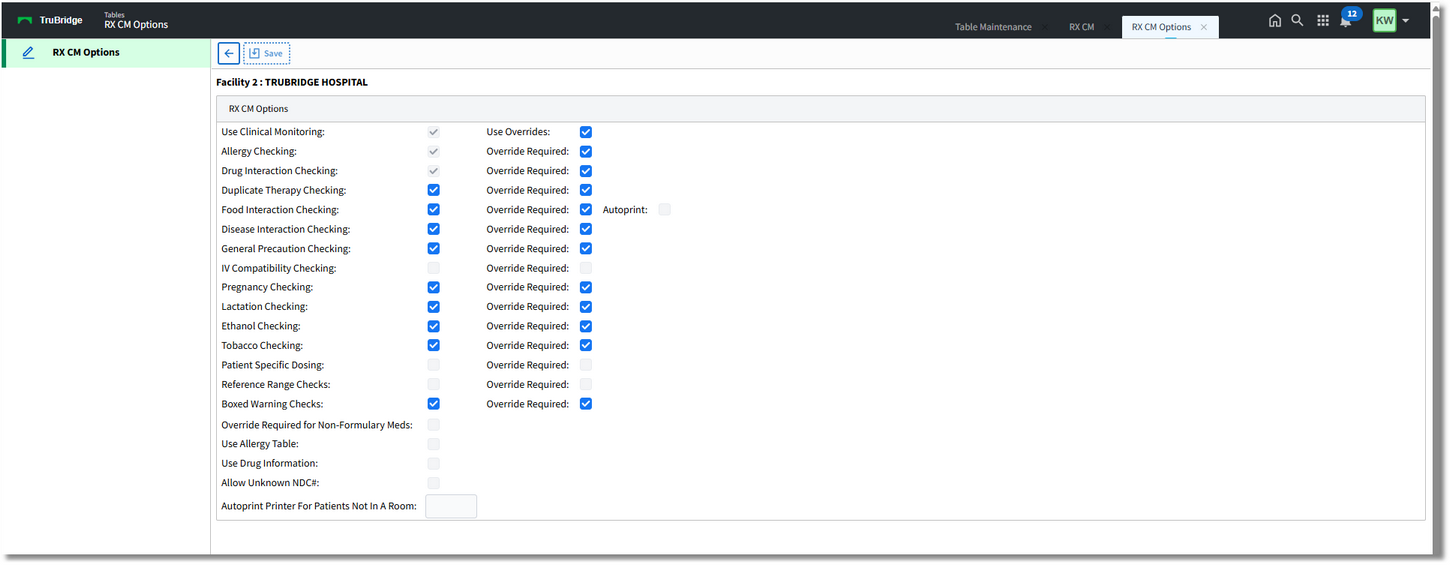
RX CM Options
•Use Clinical Monitoring: Activates Clinical Monitoring for prescription entry. This field is grayed out, but always checked "yes," since some Clinical Monitoring checks are required to meet PI requirements.
•Allergy Checking: Allows the system to automatically perform allergy checks at the time of prescription entry. Whenever a drug is entered for a patient, the system compares the new medication to any drug allergy entered on the patient through the TruBridge system. If there are any drug allergies documented that correspond to the medication selected, a menu will display showing the drug selected, the allergy, the drug class, and any possible symptoms. This field is grayed out but always checked "yes," since this Clinical Monitoring check is required to meet Meaningful Use. Include Inactive Ingredients is not available for prescription entry clinical monitoring.
•Drug Interaction Checking: Allows the system to automatically perform drug interaction checks at the time of prescription entry. Whenever a drug is entered for a patient, the system compares the new medication to all medications the patient is currently taking or has taken within the last 24 hours. Any possible interactions will display. The drug interactions are ranked as contraindicated, major, moderate, or minor. This field is grayed out but always checked "yes," since this Clinical Monitoring check is required to meet Meaningful Use.
•Duplicate Therapy Checking: Select the check box to allow the system to automatically perform duplicate therapy checks at the time of prescription entry. As soon as a medication is selected to be dispensed, the patient’s current prescriptions are reviewed for duplicate therapy. The Clinical Monitoring Screen appears, and under Duplicate Therapy, the similar medication is listed. If an active medication is continued via Prescription Writer, the system performs this check by looking at the NDC number on the order, which pulls from Pharmacy Info page 1, and creates the prescription based on that NDC but includes the full item description from Truven Micromedex. If a new prescription is created in Prescription Writer by using the New Prescription option, the NDC is pulled directly from Micromedex and duplicate therapy checking is performed based on that.
NOTE: Duplicate Therapy Checking is not performed on discontinued orders.
•Food Interaction Checking: Select the check box to allow the system to automatically perform food interaction checks at the time of prescription entry. If a medication that has an interaction to food is selected, the Clinical Monitoring screen displays.
NOTE: The Autoprint option next to Food Interaction Checking is not used by Prescription Clinical Monitoring.
•Disease Interaction Checking: Select the check box to allow the system to automatically perform drug-disease interaction checking at the time of prescription entry. Whenever a drug is entered from the Drug Formulary for a patient, the system compares the new medication to the diagnosis for the patient to ensure the drug does not interfere with the diagnosis. It will also provide a drug/drug screening for current medications, checking for disease monitoring.
•General Precaution Checking: Activates or deactivates General Precaution Checking, which screens a medication's active and inactive ingredients against the patient's age and gender to help determine whether the order should be continued. This checking more specifically provides individual and daily dosing information for pediatric, adult, and geriatric age ranges.
•IV Compatibility Checking: IV compatibility checks are not performed during prescription entry.
•Pregnancy Checking: Select the check box to allow the system to automatically perform pregnancy checking for females (based upon age range) during prescription entry. If a medication that is a risk for pregnant women is entered, the clinical monitoring screen will display the drug name involved in the pregnancy warning and the level of severity.
•Lactation Checking: Select the check box to allow the system to automatically perform lactation checking for females (based upon age range) during prescription entry. If a medication that is a risk for lactating women is entered, the clinical monitoring screen will display the drug name involved in the lactation warning and the level of severity.
NOTE: MAS will consider any female in this age range to be pregnant or lactating, regardless of what is specified for these patient attributes in the MAS Screening Request.
•Ethanol Checking: Select the check box to allow the system to automatically perform ethanol checking during prescription entry. If a medication that has an interaction with ethanol is entered, the clinical monitoring screen will display the drug name involved in the ethanol warning and the level of severity.
•Tobacco Checking: Select the check box to allow the system to automatically perform tobacco checking during prescription entry. If a medication that is not compatible with tobacco usage is entered, the clinical monitoring screen will display the drug name involved in the tobacco warning and the level of severity.
•Patient Specific Dosing: Patient Specific Dosing checks are not performed during prescription entry.
•Reference Range Checks: The system does not check against laboratory reference ranges during prescription entry.
•Boxed Warning Checks: Select the check box to allow the system to automatically perform checking for boxed warnings during prescription entry. If a medication with a boxed warning is entered, the clinical monitoring screen will display the drug name with the boxed warning and the message "A Boxed Warning was identified for this medication."
NOTE: No drug monograph exists for a Boxed Warning.
•Use Overrides: Select the check box to allow the user to enter override reasons at the time of order entry for any medication that meets the checks described above. Custom override reasons may be added in the Overrides section below and can be set for each type of Clinical Monitoring check.
•Override Required: Select the check box adjacent to each type of Clinical Monitoring Check that requires a reason be documented before proceeding with order entry.
•Override Required for Non-Formulary Meds: This option is not used during prescription entry clinical monitoring.
•Use Allergy Table: This option is not used during prescription entry clinical monitoring.
•Use Drug Information: This option is not used during prescription entry clinical monitoring.
•Allow Unknown NDC#: This option is not used during prescription entry clinical monitoring.
•Autoprint Printer For Patients Not In A Room: This option is not used during prescription entry clinical monitoring.
•Save: Once any changes are made, be sure to select Save from the action bar.
•Back Arrow: Select the back arrow to return to the previous screen.